

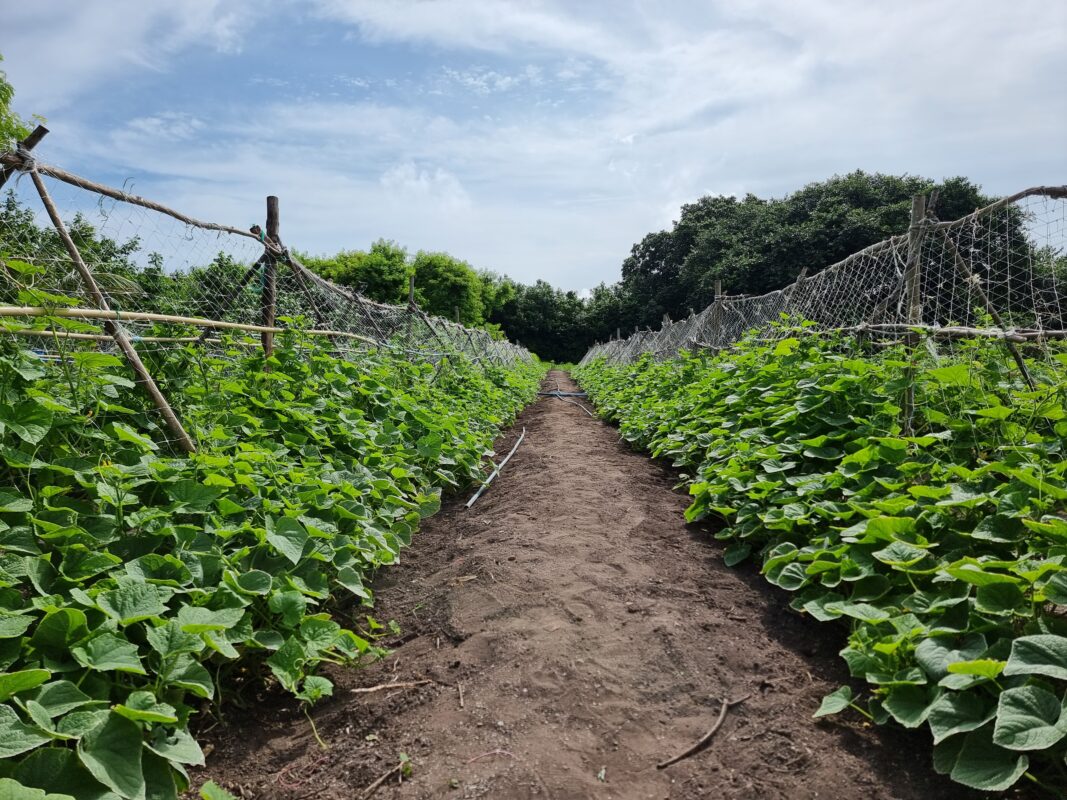
Farming in the Maldives is shaped by conditions very different from those found in large agricultural regions. Limited land, sandy soils, tropical weather, freshwater constraints and the need to transport goods between islands all influence how crops are grown.
At Madidhoo, these conditions have shaped agricultural practices over decades. Farming on the island is not simply a matter of planting and harvesting. It requires adapting cultivation methods, infrastructure and day-to-day operations to an island environment.
Working With Island Soils
The natural soils of Maldivian islands are generally light and sandy, with limited ability to retain water and nutrients.
For agriculture, this means growing areas often require careful soil management. Organic matter, growing media and other inputs can be used to improve conditions around crops, while irrigation and nutrient management must be closely coordinated.
Different crops also respond differently to island conditions. Selecting suitable crops and adjusting cultivation methods are therefore important parts of maintaining productive growing areas.
At Madidhoo, practical experience accumulated over many years helps guide decisions about where and how different crops are grown.
Managing Water Carefully
Freshwater is one of the most important resources in island agriculture.
High temperatures can increase water demand, while sandy soils allow moisture to drain relatively quickly. Rainfall can provide valuable water, but its timing and quantity vary throughout the year.
Reliable irrigation therefore plays an important role in maintaining crops between periods of rainfall.
Water management also involves using available resources efficiently. The objective is not simply to supply water, but to provide appropriate amounts at the right time while avoiding unnecessary loss.
Heat, Rain and Humidity
The tropical climate makes year-round cultivation possible, but it also creates challenges.
Strong sunlight and high temperatures can place stress on some crops. Heavy rainfall can temporarily saturate growing areas, while prolonged wet conditions and high humidity can increase the risk of certain plant diseases.
These conditions influence planting schedules, crop selection and routine farm management.
Rather than treating the climate as a fixed advantage or disadvantage, farming on a Maldivian island requires responding to changing conditions throughout the year.
The Influence of the Sea
On an island, the marine environment is never far away.
Salt carried by wind and sea spray can affect vegetation, particularly in more exposed areas. Coastal conditions can also influence soil and water quality.
The location of cultivation areas, protection of crops and management of water resources therefore become especially important.
This is one of the factors that distinguishes island agriculture from farming farther inland in larger countries.
Supplies Have to Cross the Sea
Agriculture depends on a regular supply of seeds, growing materials, equipment, spare parts and other inputs.
For an island farm, almost all of these have an additional logistical stage: they must be transported by sea.
The same applies in the opposite direction. Once produce is harvested, it has to be handled and transported from the island to customers and markets.
Weather, vessel schedules, loading and unloading, storage and timing can all affect this process.
As a result, transport and logistics are not separate from agriculture at Madidhoo. They are part of the farming operation itself.
Maintaining an Agricultural Island
A productive farm also depends on infrastructure beyond the cultivation areas.
Irrigation systems, machinery, vehicles, buildings, roads, power systems and transport equipment all require maintenance. When something fails on an island, obtaining replacement parts or specialist assistance can take longer than it would in a major population centre.
Preventive maintenance and the ability to solve practical problems on-site are therefore particularly valuable.
Over time, these supporting systems have developed alongside agriculture at Madidhoo.
Farming Through Adaptation
There is no single technique that removes all the challenges of farming in an island environment.
Successful cultivation depends on continually adapting to soil conditions, weather, water availability, crop performance, pests, logistics and changing market requirements.
For Madidhoo, more than four decades of agricultural activity have created a body of practical experience specific to the island.
The environment continues to shape how farming is carried out, while improvements in agricultural methods, irrigation, infrastructure and technology provide new ways to respond to those conditions.
That process of adaptation remains an essential part of agriculture in Madidhoo.